Human and AI: Better Together in the Cancer Registry
Cancer registrars are expected to keep pace with expanding requirements, improve timeliness, and deliver increasingly complex analytics, often without the option to add more staff. It is no surprise that the conversation turns to technology: automation, smarter workflows, and AI-supported casefinding and abstraction. But when AI is introduced as part of a “do more with less” strategy, it can feel like a fundamental shift in how registry work is valued. Many registrars hear “AI automation” and immediately think loss of control, decreased productivity, or zero return on investment. In practice, the strongest model is not replacement of the registrar, it is partnership with AI.
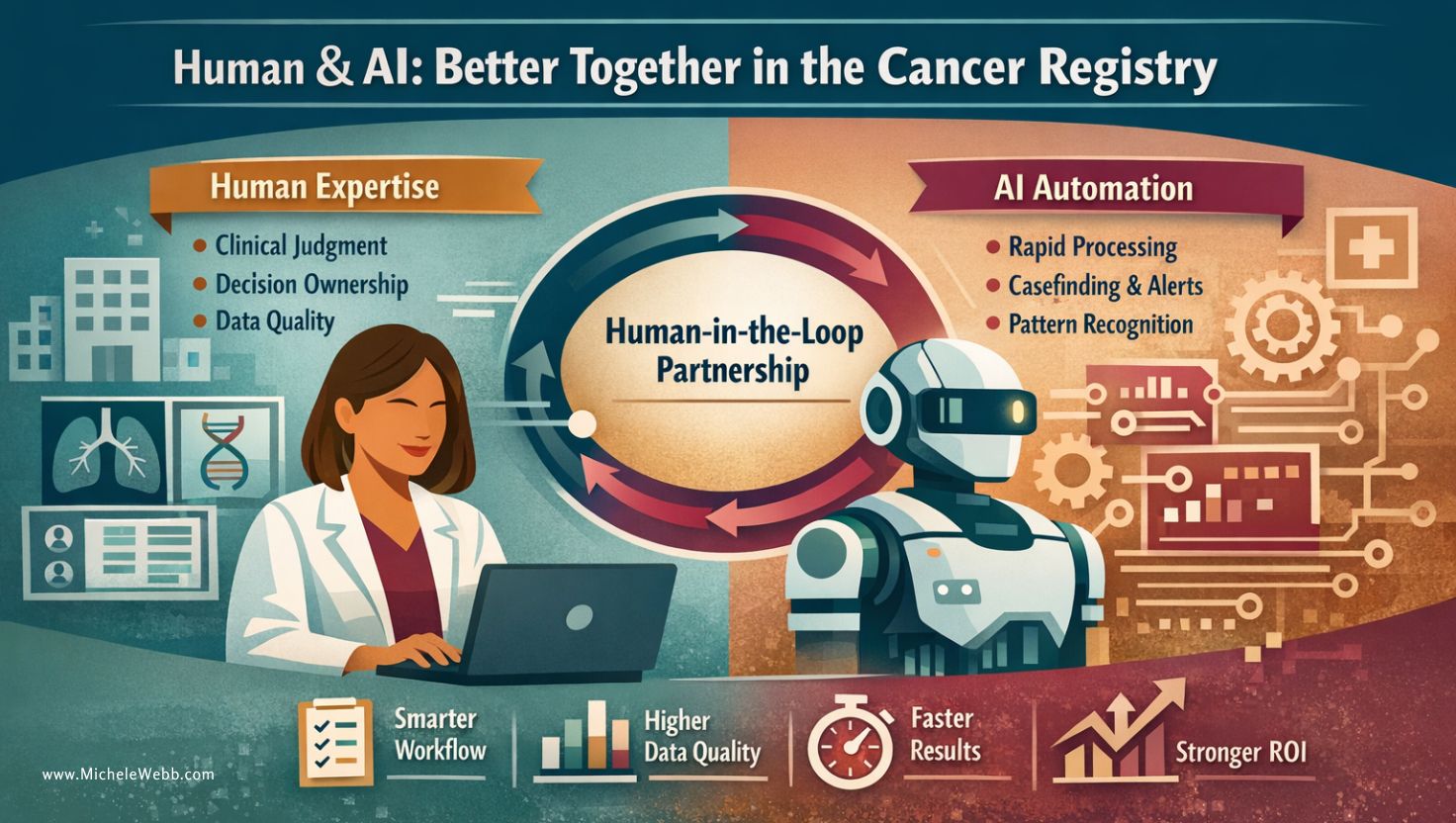
The core premise is straightforward: human and AI intelligence are complementary, not interchangeable. Humans bring judgment, empathy, and context. AI automation brings speed, scale, and consistency. And in the cancer registry, that distinction matters because our highest-value work is decision work, interpreting clinical nuance, resolving conflicting source documents, applying standards appropriately, supporting clinical and administrative data use, and owning accountability.
This is where AI can add real value, without diminishing the registrar’s role. AI is best positioned to absorb high-volume, repeatable, signal-detection tasks by finding what matters in a pile of information and surfacing the “most likely” matches for review, so the registrar can spend more time where their subject matter expertise is truly needed.
Just as important, AI should not “decide instead of the cancer registrar.” The practical and safest design is one where AI prioritizes, flags, suggests, and standardizes, while the registrar confirms, corrects, and documents, with clear override authority. In other words, the technology accelerates the work, but the cancer registrar remains the accountable decision owner.
It is at this point where ROI becomes tangible and increases over time: higher data quality, more throughput, and stronger trust and adoption across the cancer registry team. AI does not remove control; it makes control more meaningful by shifting it away from repetitive scanning and toward the decisions that truly require expertise. The goal is not full automation that excludes the registrar, it is human-in-the-loop design, where the registrar retains final authority, can override when needed, and documents decisions clearly.
For human-in-the-loop design to work well, the technology must be transparent and explainable. Teams should be able to understand how the system is reasoning, validate it, and correct it early, before small issues become scaled problems. If your program is evaluating AI, a practical approach is to start small, define roles and decision ownership up front, and track measurable outcomes such as less rework, fewer backlogs, decreased error rates, and meaningful timeliness gains. That is how we replace common misbeliefs such as “loss of control” and “no ROI,” with a controlled, accountable workflow that strengthens quality and builds ROI consistently over time.
This article first published on LInkedIn. Click here to view.
\ Get the latest news /