
AI Skills for the ODS
Cancer registrars do not need to become data scientists to evaluate AI-enabled registry technology. They do need enough fluency to understand what a system is doing, how well it performs, where ODS judgment remains non-negotiable, and whether the technology improves the cancer-data lifecycle from case identification through actionable use. Frequently I am contacted by students […]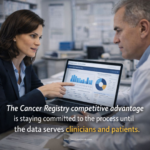
Cancer Registry Defines Next Steps
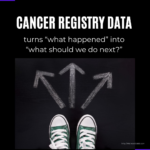
Cancer registry data is the bridge between clinical reality and operational decisions, because it does not just record events, it makes them actionable. “What happened” becomes “what do we do next” when registrars deliver standardized, decision-grade data fast enough to influence pathways, clinical decisions, and service-line strategy. Automation and workflow optimization is the amplifier: it […]
Bridge Between Clinical and Operational Reality
Cancer registry data does not just describe care, it makes care measurable, comparable, and accountable across silos, sites, and time. When we translate clinical reality into operational truth, we turn anecdotes into evidence and dashboards into decisions that actually change outcomes. The question is not whether we have data, it’s whether we are using it […]
Decision-Ready Data: Where Is It?
Assets like the cancer registry are, by design, used to amplify and strengthen the oncology service line. Each case in the Registry contains decision-ready data that is carefully coded and validated by an ODS who received specialized training. The equation looks like this: ODS + Workflow Optimization + Validated Data = Clinical and Operational Decision […]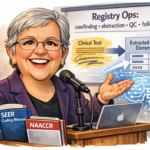
It’s a Privilege
It has been my honor and privilege to serve as a cancer registrar, speaker, and author for the past 20+ years! Registrars are a unique healthcare professional, highly trained in anatomy and physiology, cancer disease process, and the healthcare delivery process. Not only has clinical and scientific medicine changed dramatically since I first started, but […]
What It Means When a Cancer Registrar Says, “There Is No Room for AI in the Cancer Registry”
Why do cancer registrars say, “There is no room for AI in the cancer registry?” As a cancer registrar who advocates for thoughtful AI automation, I hear this phrase often. In most cases, it is not opposition to innovation. It is a signal of perceived risk without control. AI has been part of registry work […]