
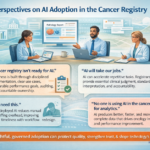
Perspectives on Registry Automation: Firestorm or Reality?
Recent perspectives on the adoption of AI to support cancer registry casefinding, abstraction, and analytics have landed differently across the community. The intensity of the feedback signals something important: a shared commitment to data integrity, accurate patient stories, and the long-term credibility of cancer registry work. To move the conversation forward, it helps to set […]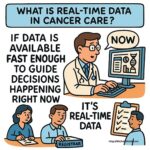
What is Real-Time in Cancer Care?
How do you define real-time data in cancer care? Across oncology, “real-time” data is increasingly defined not by a specific number of minutes or hours, but by its ability to meaningfully inform current clinical or quality decisions. NAACCR’s Real-Time Reporting Taskforce distinguished true real-time processing as “…data captured and available essentially as events occur…” from […]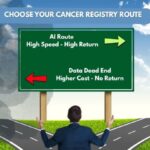
Cancer Registries Are at a Fork in the Road
Cancer registries face a turning point. Case-finding, abstraction, and follow-up once depended entirely on manual effort, but data demands have grown exponentially in the last decade. Hospitals now require near real-time information to support quality reporting, value-based care, personalized medicine, and population health. Artificial intelligence (AI) offers a solution, but adoption requires engagement and clarity […]
Symptoms Tell a Story
Myelofibrosis begins quietly. Your case finding practice makes a difference. Primary myelofibrosis often begins quietly — fatigue, anemia, maybe a larger spleen — until it becomes a diagnosis hidden in plain sight. For Oncology Data Specialists, catching those early signals in the record can mean the difference between “missed” and “found.” Spotlight on Myelofibrosis – […]
Close the Gap: Hematology
Clinical data tells the story pathology cannot. Roughly 8–12% of hematologic malignancies are clinically diagnosed rather than pathologically confirmed (Deppen et al., 2020; CDC USCS, 2025). Without deliberate data curation, they may never be reviewed or abstracted by the cancer registry. When medical disease indices (MDI) are pre-filtered and do not include all ICD-10 codes, […]
Think Beyond the Obvious
The real challenge is finding what was missed. In an earlier post we explored how clinically diagnosed lung cancers often escape case finding. But the problem runs deeper: incomplete casefinding does not just miss patients—it reshapes the national picture of cancer itself. When symptom-based encounters, LDCT screening and imaging reports with ambiguous terminology, or clinical […]
Case Finding is the Foundation
Finding EVERY cancer case is not optional.It is foundational to cancer program integrity. Casefinding is not just a cancer registry workflow. It is the foundation of every cancer program quality measure, accreditation, and KPI. Without it, the cancer registry is not only under-performing but puts the hospital credibility at risk. Every case matters and cancer […]
Cancer Registry Data Stewardship
Cancer Registry data curation isn’t extra.Good stewardship drives change. Cancer registrars have always shouldered the responsibility of abstracting data, but the role now demands more. In this series, we’ve shown how registrars can move beyond manual tasks to become curators of real-time, accurate, and actionable data. The final step in this transformation is stewardship. Stewardship […]