What It Means When a Cancer Registrar Says, “There Is No Room for AI in the Cancer Registry”
Why do cancer registrars say, “There is no room for AI in the cancer registry?” As a cancer registrar who advocates for thoughtful AI automation, I hear this phrase often. In most cases, it is not opposition to innovation. It is a signal of perceived risk without control.
AI has been part of registry work for decades. Early applications supported casefinding as far back as the 1980s, and modern tools now extend into intelligent extraction and workflow support across casefinding, abstracting, follow-up, quality control, and analytics. So when a registrar pushes back on AI tools, the concern is usually not “AI itself,” but what AI could change in the day-to-day reality of producing defensible cancer data.
What the Resistance Often Means
The phrase usually points to a specific set of operational and professional concerns, including:
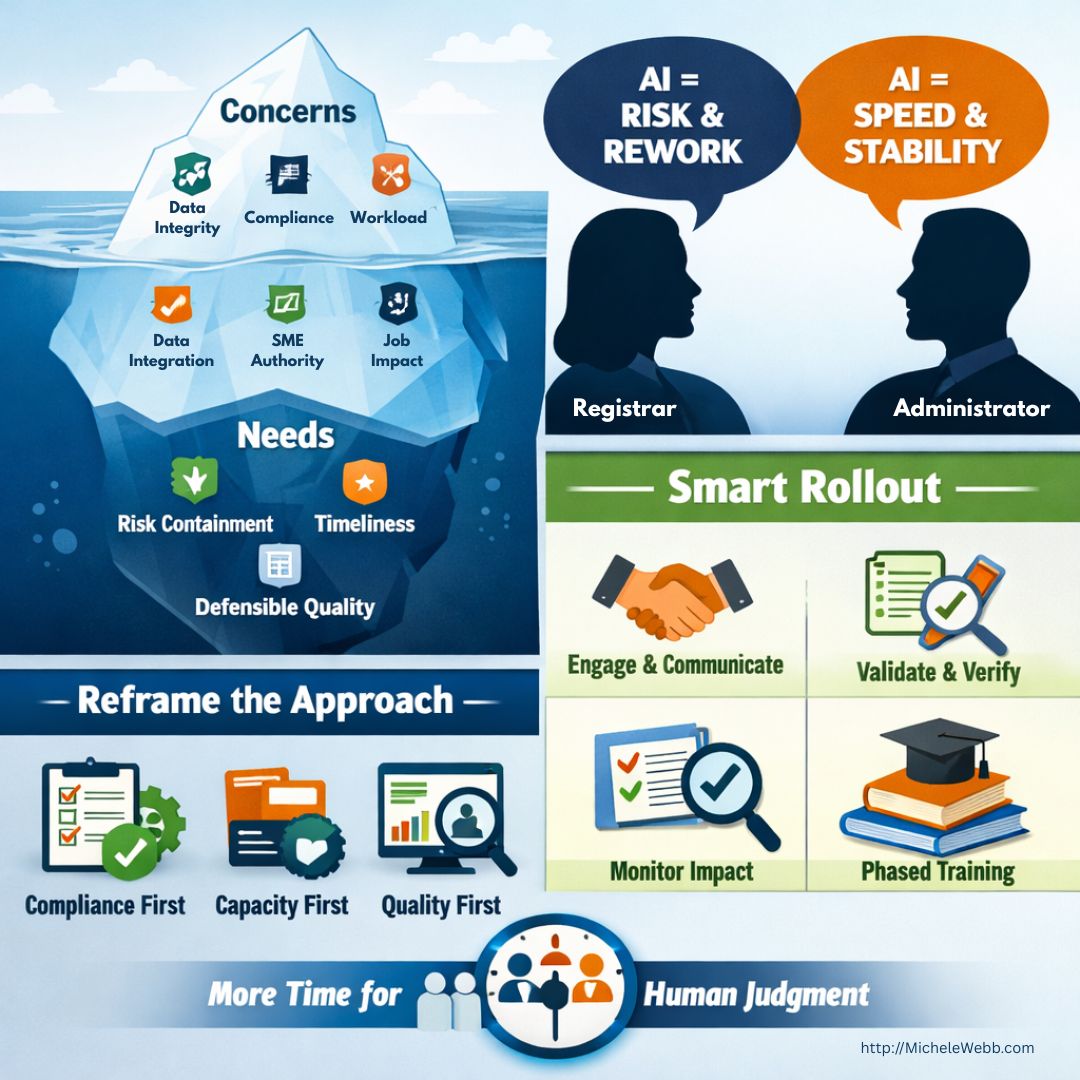
- Data integrity: false positives, false negatives, edge cases, and error propagation
- Compliance: defensibility, traceability, and the “why” behind inclusion or extraction
- Operations: increased rework, a shift toward quality control, and dual processing during rollout
- Loss of SME authority: workflow ownership drifting to a vendor or an algorithm
- Job impact: staffing pressure, productivity or quota creep, and role de-skilling
Underneath these concerns are non-negotiables: risk containment, predictable throughput, timeliness, defensible data quality, cost control, and protecting the strategic value of cancer data.
Two Lenses, One Message
In many organizations, registrars and administrators interpret the same message through different lenses. Registrars often hear, “AI equals risk, rework, accountability without control, and staff reductions.” Administrators often hear, “AI equals the fastest path to timeliness, stability, time reallocation to high-value work, and executive visibility.”
Both perspectives contain legitimate priorities. The implementation risk occurs when only one lens drives decisions. Reframing concerns on both sides helps bridge communication gaps and realign teams around shared goals and a common vision for efficiency and long-term success.
Three Practical Ways to Move From Resistance to Adoption
1) Compliance-first: Address defensibility concerns early. Require audit trails, version control, measurable concordance, and clear source provenance. Keep human-in-the-loop review and judgment as the final gate—registrars remain the SME gatekeepers.
2) Capacity-first: Establish controls that reduce document routing and non-value work before changing core casefinding or abstraction decision-making. Early wins should remove friction, not add it.
3) Quality-first: Provide training and open communication on how AI is used to catch misses, standardize inputs, and surface exceptions. The goal is not to replace expertise, but to shift registrars away from hunting documents and tracking every data element so they can focus on validation, outliers, and improvement.
What Adoption Requires
To support adoption and engagement, lead with communication and hands-on involvement. Use a phased rollout that respects workload and learning curves. Define decision-making rights and escalation paths. Require data validation before scale, and measure net workload impact after go-live—not just throughput.
The cancer registry does not need less Oncology Data Specialist involvement. It needs more time. AI-driven tools can help cancer registrars reclaim it—without sacrificing defensibility, quality, or professional ownership.
Note: this content was first published on LinkedIn. Click here to view original post.
\ Get the latest news /