Perspectives on Registry Automation: Firestorm or Reality?
Recent perspectives on the adoption of AI to support cancer registry casefinding, abstraction, and analytics have landed differently across the community. The intensity of the feedback signals something important: a shared commitment to data integrity, accurate patient stories, and the long-term credibility of cancer registry work.
To move the conversation forward, it helps to set aside individual and emotional reactions and ground the discussion in operational reality. Forms of AI-enabled automation have existed in cancer registry–adjacent workflows for years. What is changing now is the capability, sophistication, and reach of these tools across end-to-end registry processes.
Several themes consistently surfaced in the response:
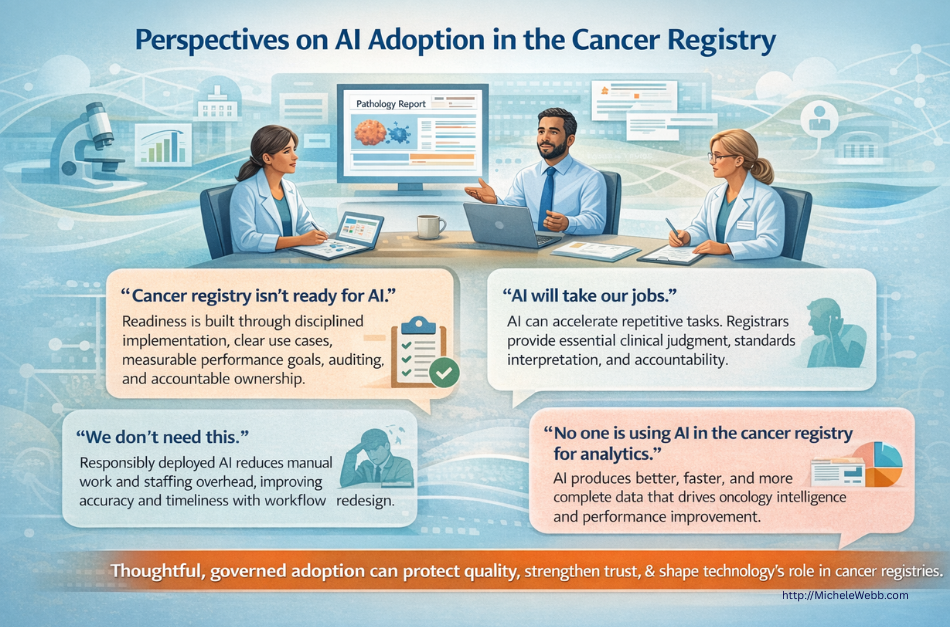
“Cancer registry isn’t ready for AI.”
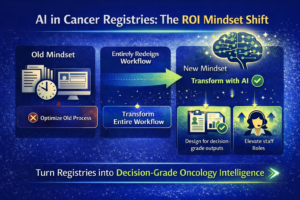
It can feel that way—especially when AI tools are layered onto existing workflows without governance, validation, or transparency. But readiness is not a fixed state; it is built. Readiness comes from disciplined implementation: clearly defined use cases, measurable performance goals, well-specified expected outputs, ongoing auditing, and accountable ownership. It also requires workflow redesign that aligns with the patient journey and the speed needed for clinical and operational decision-making.
“AI will take our jobs.”
This concern is understandable and should be addressed directly. In practice, the most effective model is human-in-the-loop. AI can accelerate repetitive, time-consuming tasks, while cancer registrars provide clinical judgment, standards interpretation, and accountability that technology cannot replace. Over time, refusing to engage may pose a greater risk to the registrar role than learning to apply these tools responsibly to strengthen performance, impact, and relevance.
“We don’t need this.”
Many registry teams are already stretched thin, with capped or limited workforce and resources. When responsibly deployed, AI has demonstrated the ability to reduce manual work and staffing overhead while improving accuracy and timeliness without sacrificing quality—particularly when paired with workflow redesign, rather than being added on top of outdated or heavily manual processes.
“No one is using AI in the cancer registry for analytics.”
Research and real-world experience point in the opposite direction. The long-term value of AI is not limited to efficiency gains; it includes enabling better, faster, and more complete data that can drive oncology intelligence, quality measurement, service line planning, disparities work, and performance improvement. Strong implementations define the analytics and insights expected at the outset and design the deployment around cancer registry data integrated with other key sources. Treating analytics as an afterthought typically results in rework, higher costs, and delayed impact.
This is not a call for blind adoption. It is a call for thoughtful, governed adoption—where oncology administrators and cancer registrars help lead the work, protect quality, strengthen trust, and shape how technology is used within cancer programs.
\ Get the latest news /