How to Get ROI on Cancer Registry AI Software
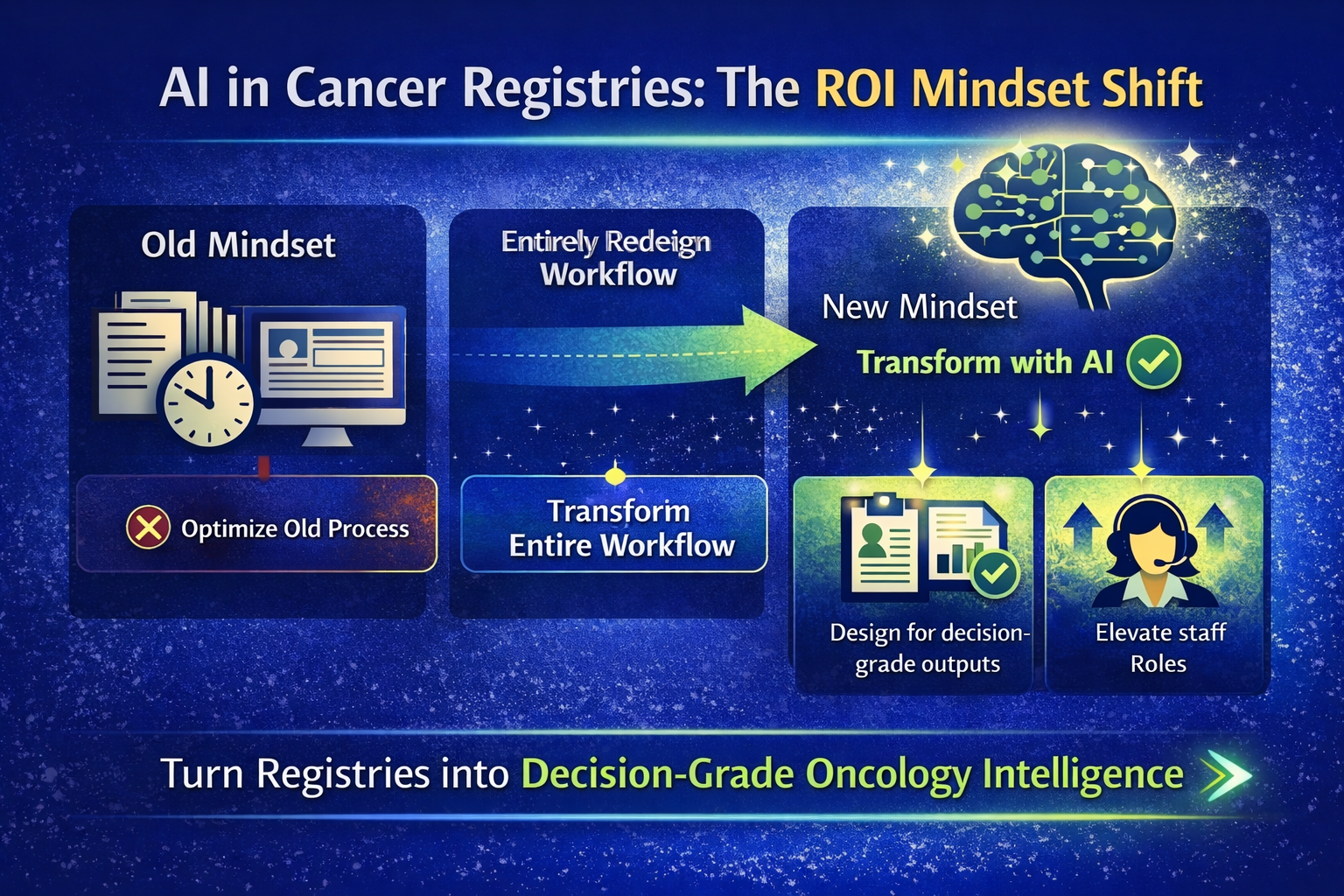
When cancer registry AI software does not deliver the expected ROI, it is tempting to assume the technology is not working. Often, the real issue is that AI is being used to “optimize” workflows that were designed for manual work, legacy systems, and batch reporting. Instead of redesigning the end-to-end process, organizations layer AI onto the same steps and ROI stays inconsistent.
A Wired/EY perspective framed today’s AI “winners” as the organizations that scale deliberately, not experimentally. That principle applies directly to cancer registry operations. AI produces measurable value when it is treated as operational transformation, not a software add-on. ROI does not come from smarter tools applied to the same process, it comes from changing the process from beginning to end.
The mindset shift: from optimization to reinvention
High-performing cancer registries, and the oncology data specialists who lead them, make three practical shifts.
1) Reimagine the workflow, not the old process.
Reinvention does not have to mean “rip and replace,” but it does require stepping back and redesigning the workflow end-to-end. When AI is integrated into the sequence of work instead of bolted on at the end, steps consolidate, handoffs simplify, and time-intensive work can drop dramatically without sacrificing quality.
2) Design for both inputs and outputs.
Registry work is a transformation pipeline. The input is how we capture and structure the patient’s cancer story—signals, source documents, abstracted data, and clinical context. The output must be decision-grade data that informs action: quality initiatives, program performance, service line planning, research readiness, and timely reporting. If outputs don’t change decisions, ROI will remain elusive, regardless of the technology.
3) Reinvent the role so staff arenot doing “old work plus AI.”
The best implementations do not add new tasks to registrars’ plates. They redesign work so Oncology Data Specialists spend less time on repetitive manual steps and more time on higher-value review, validation, problem-solving, innovation, and timeliness. This is where ROI is generated, and how the workforce is future-proofed
Why this matters for registrars, students, and administrators
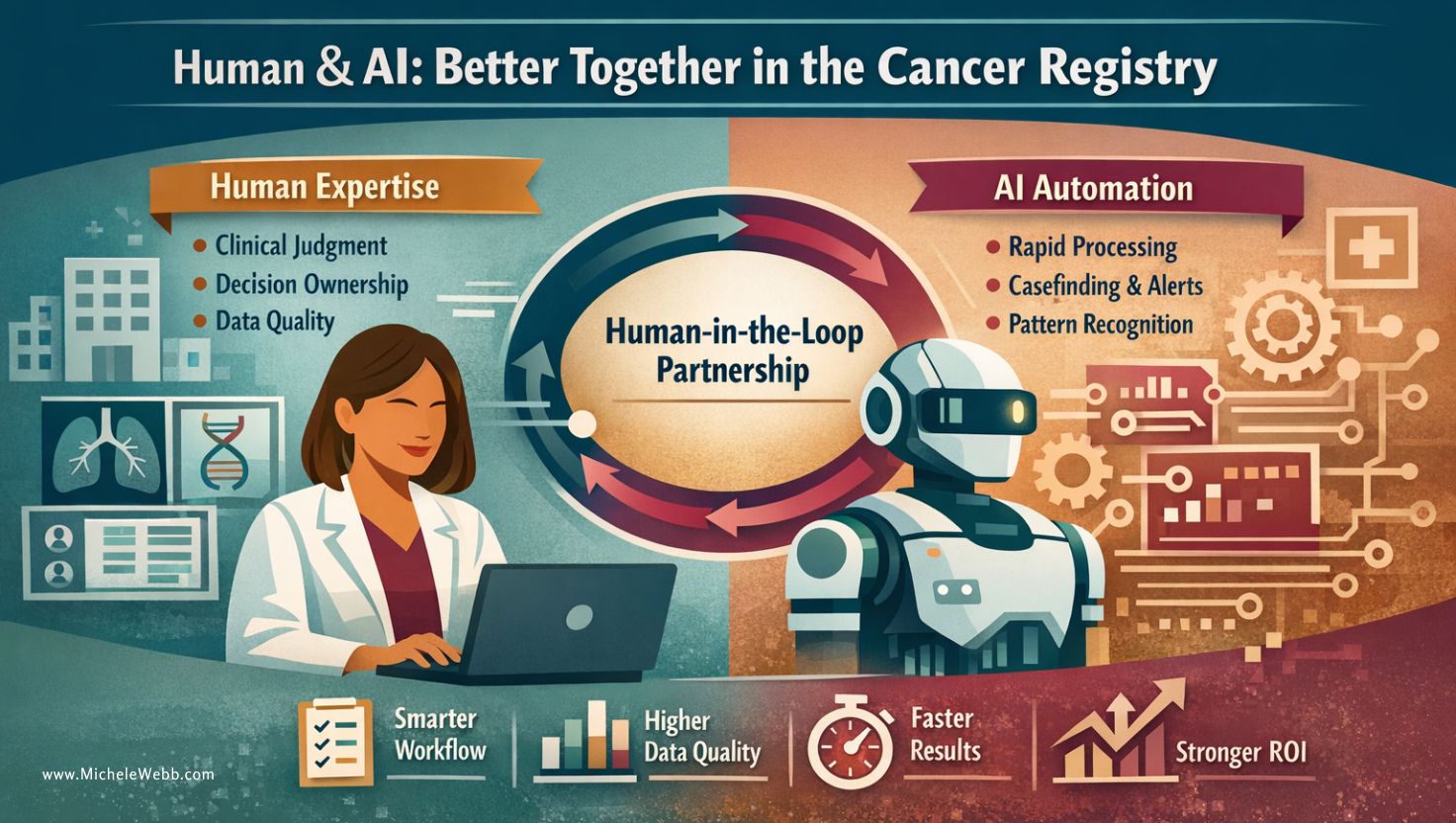
For registrars and registry students, the takeaway is straightforward: AI does not replace expertise, it amplifies it. The durable advantage is still the judgment and domain knowledge of cancer registrars; AI simply increases leverage when the workflow is designed to use it well.
For oncology administrators, the operational reality is equally clear: AI value is not a feature, it is an outcome. If the registry’s end-to-end workflow stays the same, ROI will be limited. When outputs are redesigned around decisions and performance, the registry becomes more than compliance, it becomes an oncology intelligence asset.
Conclusion
AI ROI does not come from layering tools onto the same workflow. It comes from redesigning the work so registrars spend less time on manual steps and more time on high-value validation, review, and data quality. That is when the cancer registry shifts from “required reporting” to decision-grade oncology intelligence, and ROI becomes the natural result of a better operating model.
(This article first published on LinkedIn. Click here to view.)
\ Get the latest news /