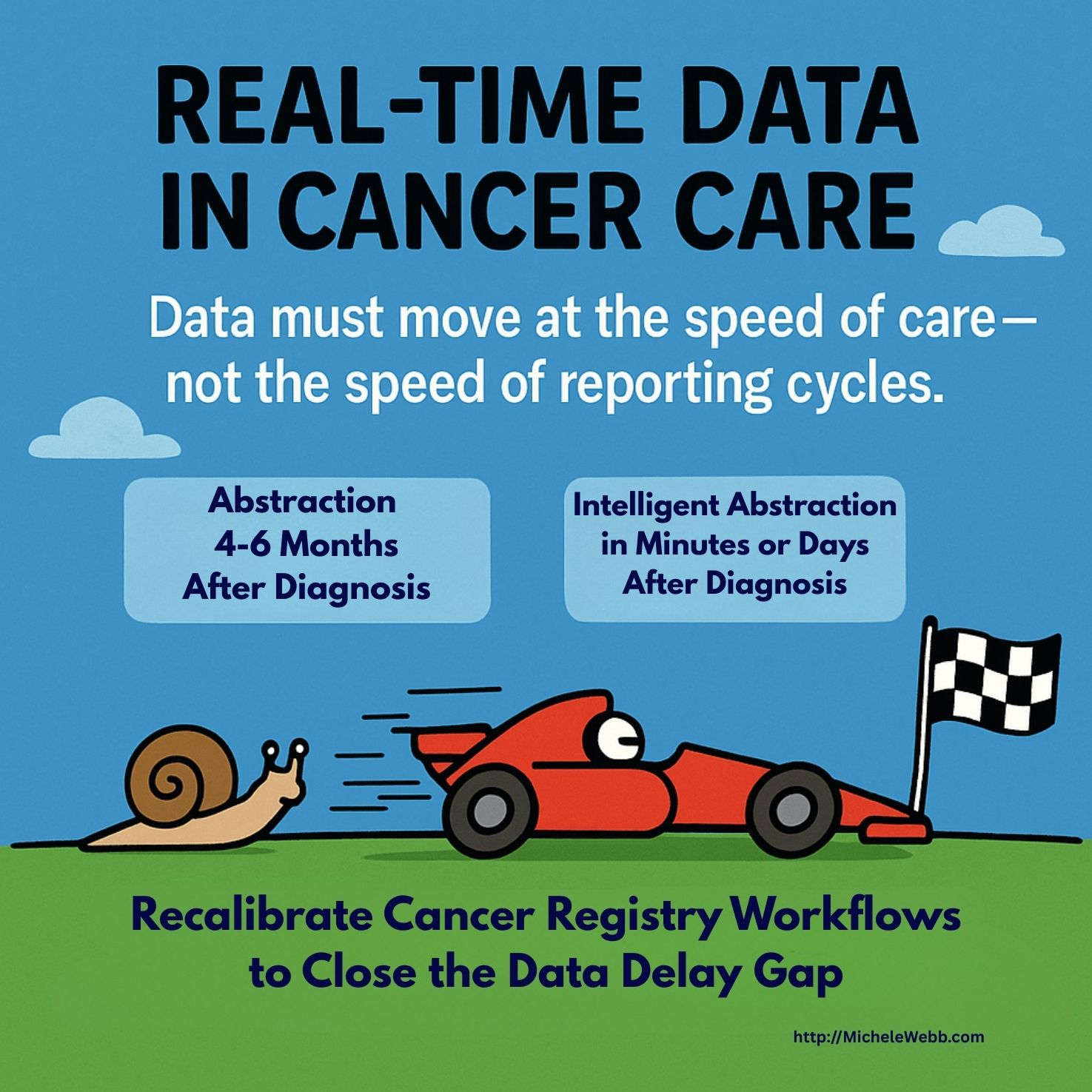
What is Real-Time in Cancer Care?
How do you define real-time data in cancer care?
Across oncology, “real-time” data is increasingly defined not by a specific number of minutes or hours, but by its ability to meaningfully inform current clinical or quality decisions. NAACCR’s Real-Time Reporting Taskforce distinguished true real-time processing as “…data captured and available essentially as events occur…” from broader concepts of timeliness.
Recent work demonstrates this shift in practice: national surveillance pilots have tested real-time submissions against traditional 22-month reporting cycles, cloud-based systems now enable near real-time pathology feeds to state registries, and automated EHR integration platforms provide continuous updates to registry datasets.
At the point of care, emerging clinical decision support systems integrate clinical, genomic, and imaging data in real time, allowing oncologists to act on the most current information. Providers need this, and cancer surveillance data from the cancer registry to make treatment planning and clinical decisions as the patient is seen.
Accreditation programs such as the CoC’s Rapid Quality Reporting System further embed real-time assessment into quality monitoring. Together, these efforts demonstrate that “real-time” in cancer care is best understood as data that is captured, processed, and available fast enough to support immediate decisions in surveillance, quality, or treatment.
(Note: this article was first published on LinkedIn.)
\ Get the latest news /