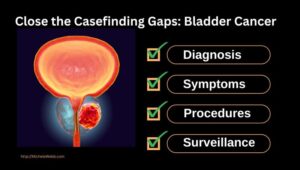
Close the Gap: Lung Cancer
1 in 10 lung cancers are clinically diagnosed.
Weak casefinding = missed cases.
Roughly 1 in 10 lung cancers in the US are not pathologically confirmed, representing thousands of clinically diagnosed cases not collected in the cancer registry (SEER, 2025). These cases may be overlooked if limited ICD-10 code sets are used that do not account for all pathways associated with screening, diagnosis, treatment, and post-treatment surveillance of lung cancer (CDC USCS, 2025).
Procedures, such as low-dose CT (LDCT) screening, also carry a high probability for reportability. Cases warranting registrar review often contain ambiguous terminology such as spiculated or enlarging nodules, mass-like opacities, or suspicious adenopathy, each masking a potentially reportable case (Mazzone et al., 2021).
Finally, nearly half of all lung cancers in the US are diagnosed at stage IV when curative therapy is no longer an option (CDC USCS, 2025). One large health system reported that 89% of all lung cancers were diagnosed with Stage IV disease and directly referred to hospice (Sullivan et al., 2017).
ICD-10 codes for case finding from the medical disease indices (MDI) include:
—Symptom-related: R91.8, R06.02, R05.x, R06.x, R07.x, R04.x, R09.x, R93, R94.2, R84.6
—Diagnosis, Recurrence, Metastasis: C34.x, C38.1, C38.x, C78.-C78.02, C79.31, C79.51, R56.9, R16.0
—LDCT Screening: CPT 71250, 71260, 71270, and 32408
—Post-Treatment or Surveillance: Z85.118, Z08, Z51.11, Z51.12, Z51.0, Z48.3
Arguably casefinding review of all associated patient visits is time- and labor intensive. Implementation of an AI-powered software will substantially streamline casefinding and pre-abstracting workflows and ensure all clinical and pathologically confirmed cases are collected in near real-time.
Actionable Tip
Use of all the code sets for case finding is not enough. Routine quarterly or annual case-finding audits should also be conducted to ensure accuracy and completeness and to identify gaps.
—Review MDI ICD-10 code lists in- and outpatient lists include symptoms, procedural, disease and surveillance codes. Review and update the lists annually.
—Audit unfiltered MDI’s, comparing encounters with ICD-10 codes to the cancer registry accession register. Note the gaps and identify root causes.
—Prepare a final report with results and action plan. Share with administration and Cancer Committee.
Every symptom matters. Every case counts.
First published on LinkedIn.
\ Get the latest news /