Why Saying AI Solutions Can “Do More With Less” Triggers Fear

“Do more with less.” Four words that can instantly trigger alarm for cancer registrars.
For many, the phrase activates a stress response rooted in familiar pressures: unrealistic expectations, shrinking timelines, or a perceived loss of control. When a team is already operating at maximum capacity, it can widen the gap between what leadership expects and what feels workable—fueling disengagement, cognitive fatigue, and burnout.
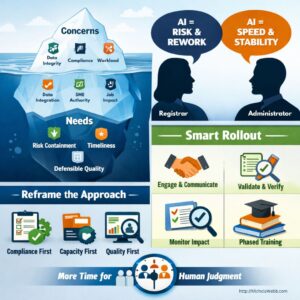
That is why clarifying what the phrase actually means in the context of AI tools in the cancer registry matters. In business, “doing more with less” typically means maximizing outcomes while minimizing critical resources like time, money, or staffing. At its best, it is about efficiency, smart prioritization, and innovation—working smarter by identifying the work that truly matters, not by squeezing people harder.
If the goal is sustainable registry performance, the “less” should be less rework, less document chasing, fewer preventable errors, and less delay in data capture. The “more” should be more high-value work: data quality, completeness, and timeliness; human-in-the-loop validation; reporting and analytics; and actionable insights that support service line utilization and more personalized care.
At its core, the concept points to three areas of focus: improving productivity with the same (or fewer) resources, being resourceful and innovative with what already exists, and maintaining strategic focus on the work that drives measurable impact.
An emotionally intelligent response to the phrase is also practical. Define what “less” means (less rework, fewer clicks, less chasing documents)—not “less people.” Start with one or two measurable initiatives and a clear definition of success. Redesign end-to-end workflows around the tool, not the other way around. Protect trust through transparency, validation, and feedback loops.
When the narrative shifts from pressure to purpose, “doing more with less” becomes “doing more of what matters, with less wasted effort.”
This post was first published on LinkedIn. Click here to view.
\ Get the latest news /