Are You Chasing Last Year’s Data?
Cancer programs cannot wait for data.
Is your registry leading the transformation?
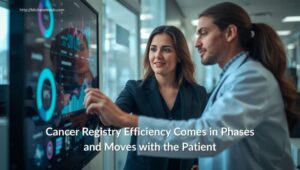
Concurrent abstracting provides important and actionable data that everyone in the cancer program needs. Imagine the cancer registry providing KPI’s to a physician showing which patients started treatment within 30 days of diagnosis. Or an administrator quickly checking an online dashboard that alerts to declining surgical volumes in the last 60 days and being able to quickly reallocate resources before revenue drops.
Researchers benefit from concurrent abstracting too: clinical trial recruitment improves when patient data is current, not six months old. Quality teams can intervene immediately when metrics slip, such as inadequate lymph node sampling or delayed chemotherapy. Studies have shown that delays in cancer registry reporting undermine quality improvement and clinical research efforts—real-time data enhances both compliance and care delivery (Palis et al, Ann Surg Oncol, 2020).
Automation powers this by linking cancer registries with pathology, radiology, radiation oncology, medical oncology, EHRs, and follow-up sources. Registrars ensure the auto-extracted data is accurate, complete, and usable. The result is a living dataset that drives daily decisions. Concurrent abstracting, in phases, creates near real-time case records that improve timeliness, reduce workload compression, and increase the utility of cancer registry data for immediate decision-making (Merriman et al, JCO Clin Cancer Inform, 2021).
Real-time registry data is not just about reporting. It’s about agility. A recent validation study of near-real-time integration between EHRs and the Netherlands Cancer Registry achieved near-perfect diagnostic and treatment accuracy—supporting swift, high-quality surveillance and care decisions (Langhout et al., iScience, 2025). Programs that use this dynamic data model lead in outcomes, compliance, and innovation; those that don’t remain are stuck managing yesterday’s problems.
Is your cancer program steering today’s care—or chasing last year’s data?
\ Get the latest news /